For growers in arid and semi-arid regions, salt buildup in the soil is a persistent challenge. Certain areas of California are currently facing the impacts of soil salinity, where salts can accumulate near the soil surface and within the active root zone, causing stress and damage to the crop.
If soil salinity gets too high, leaching salts out of the root zone becomes necessary. The challenge for many growers has always been knowing when salts are becoming a problem and whether leaching efforts are actually working.
Tracking salt in the soil
Historically, growers had limited visibility into how salts moved through the soil. Leaching was often done based on best estimates: apply extra water, then hope salts were pushed below the root zone.
The problem with this approach is the uncertainty it creates. Without clear data, it’s hard to know whether enough water was applied and whether salts actually moved out of the root zone. That uncertainty can lead to wasted water and continued stress on the crop.
Today, most agtech companies offer tools that provide growers with soil data, making salt management far more effective. However, that data is often presented in complex graphs that are difficult to act on. This is where Semios makes the difference.
Salt Map: Visualizing salinity at every depth
Semios decodes data from soil moisture probes installed in the field and translates it into a simple graph, Salt Map. Available in the Semios Hub app, the Salt Map shows salt concentration at each depth in a way that’s easy to understand and act on.
Instead of working through formulas or raw sensor data, you can quickly see how salinity is changing through the root zone. You will know that your leaching practices are effective when the Salt Map shows reduced salt levels after irrigation.
Below is an example of how the Salt Map appears in the Semios Hub app. The horizontal X-axis shows time, while the vertical Y-axis shows the soil depth in inches. The colors represent various levels of salt concentration, from low (blue) to high (red). Here, you can see that after an irrigation event, salts have been pushed deeper into the soil profile. This is shown by the changing colors from reds and oranges (higher salt concentration) to green and yellows (lower salt concentration) over time.
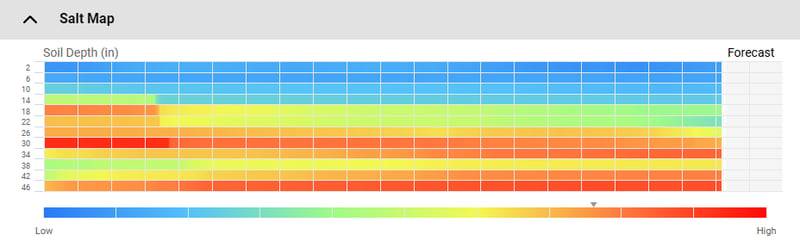
The time range shown in the Salt Map can be adjusted so you can review and compare changes over different periods of time.
This visibility is especially useful after the season, when post-harvest leaching is often used to move salts out of the upper soil profile. The Salt Map makes it easier to track whether those leaching efforts are actually improving salinity where it has an impact on your crop.
The Salt Map can also reveal patterns that are difficult to detect otherwise. After years of irrigation and leaching, some fields develop restrictive layers where salts accumulate near the bottom of the wetting zone. These are often visible in the salt map as a single row or two rows that have excessive salts. Recognizing these layers helps explain why water may struggle to move deeper and allows you to adjust leaching strategies or management practices accordingly.
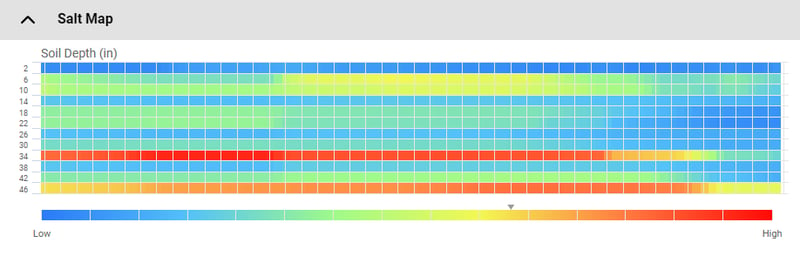
An example of a field where there’s a restrictive layer around 34 inches deep in the soil profile, highlighted by the red row that shows high salt concentration.
Tracking fertilizer movement
Fertilizer movement is another area where the Salt Map provides useful insight. Because most fertilizers are salts, applications of these fertilizers can be seen on the Salt Map. The map helps you understand whether fertilizer is moving deeper into the profile and away from the roots due to excess water. Looking at salinity trends across multiple months makes these patterns easier to spot and manage.
Rather than overwhelming users with technical detail, the Salt Map presents salinity trends in an easy-to-interpret graph. Something we consistently hear from growers is that the app makes it easier for them to understand what’s happening in the soil and respond with confidence.
Infiltration Map to understand water movement
Along with salt management, it’s also important to understand how water moves through the soil.
The Infiltration Map in the Semios Hub app is an innovative tool that shows how deeply water penetrated the soil profile after each irrigation or rainfall, helping you spot potential infiltration issues in your soil.
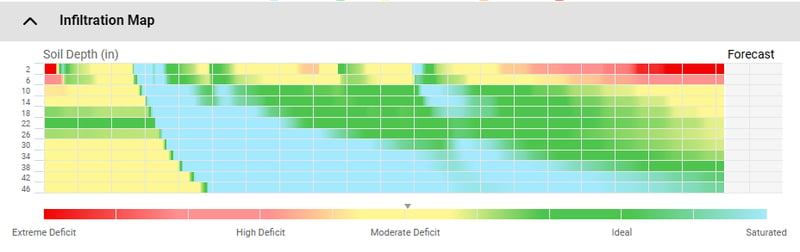
The Infiltration Map provides a clear visual representation of soil moisture, showing where in the soil profile you have saturated soil and where you have deficits. When water is being applied to remove salts from the soil, you can use the Infiltration Map to assess whether you are applying enough water to move salts from the root zone.
For a deeper look at how infiltration data works, read our blog on the Infiltration Map.
See the Salt Map in action
Salt management doesn’t need to be complicated! Reach out to our team to get a demo of the Semios Hub app and see the Salt Map in action.